Resource v1.0
(IML) Idea Mutation Ledger
A three-minute divergent-thinking protocol for K–12 classrooms and for your own lesson prep. It replaces "was that creative?" with one number: how many conceptual domains a student crossed, divided by how many ideas they wrote.
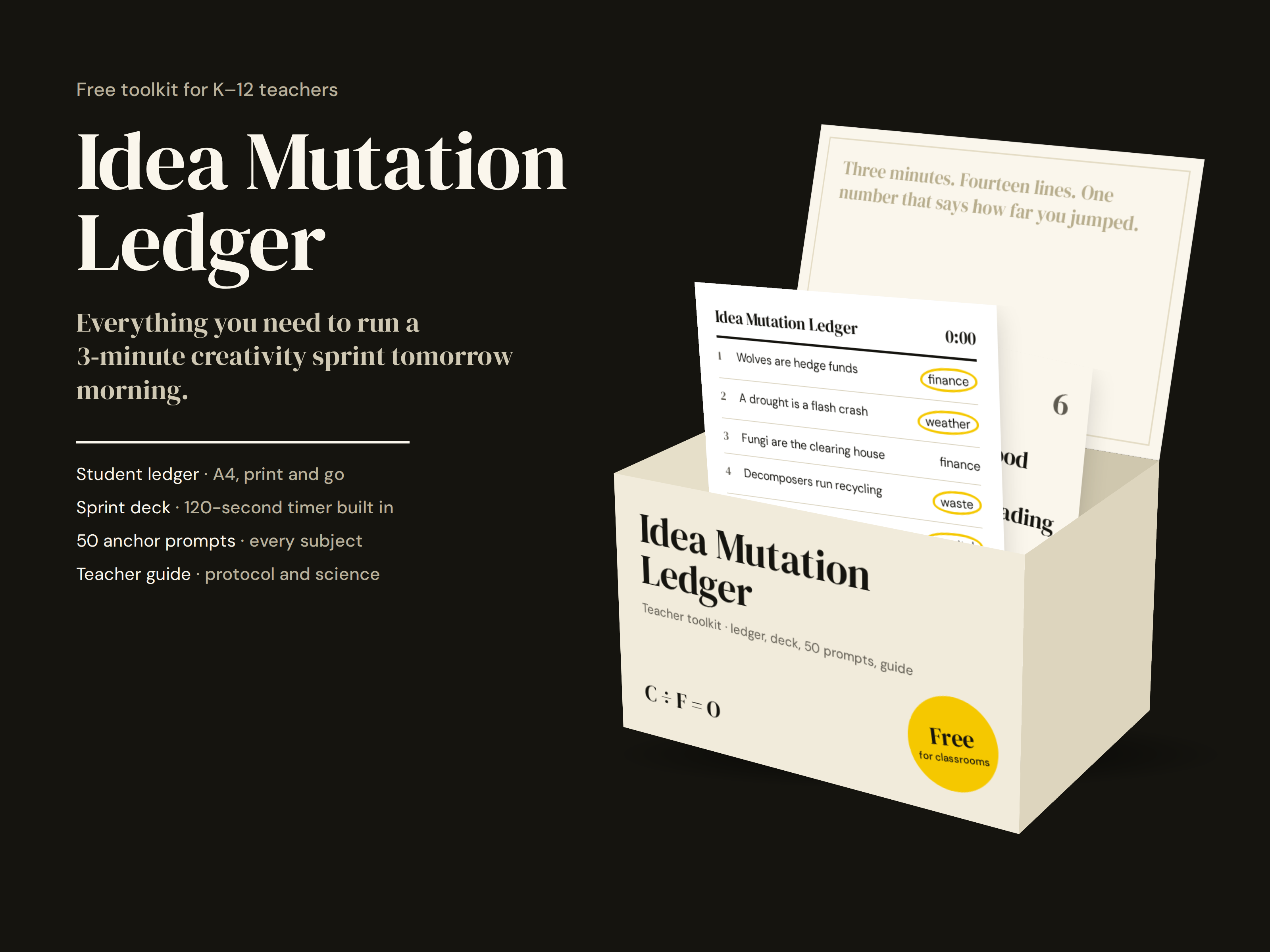
Stop guessing creativity. Start measuring domain jumps.
A zero-prep, three-minute cognitive framework for K–12 classrooms and for your own lesson design. One constraint, one sprint, one number. Science-backed and free.
Brainstorming gives you volume. The ledger gives you distance.
Open brainstorming produces the first three ideas everyone in the room already had. The Idea Mutation Ledger anchors students to an extreme constraint, makes them sprint, and then scores only one thing: how many conceptual worlds they borrowed from.
30s - The anchor
Project one prompt from the bank. "Explain continental drift using pastry physics." Read it once. Don't explain it.
120s - The sprint
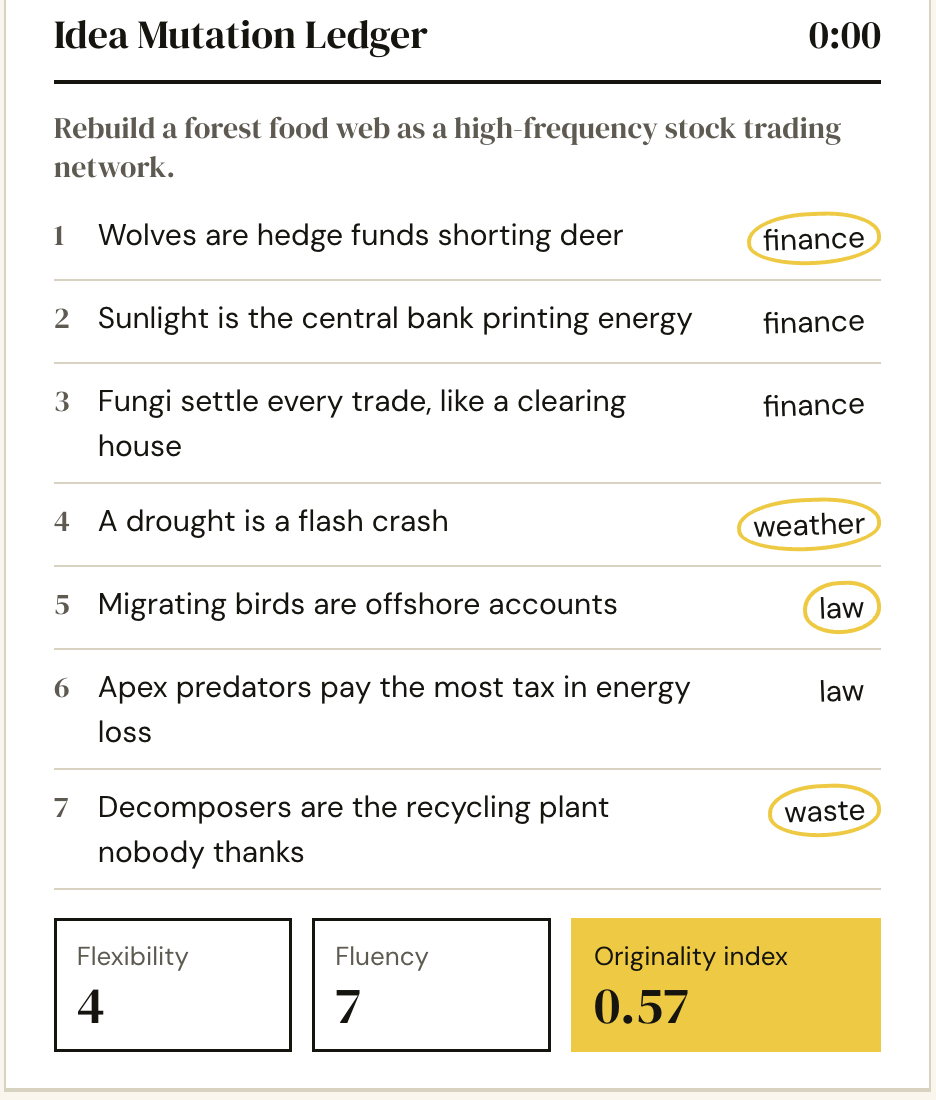
Students write up to fourteen ideas, tagging each with the world it came from. No editing, no crossing out.
60s - The audit
Swap sheets. The auditor circles every idea from a domain that hasn't appeared above it. Same world twice counts once.
30s - The score
Circles divided by lines. Then one sentence: which two ideas are furthest apart, and what connects them?
One metric, deliberately blind to taste.
The originality index measures associative distance, which is trainable, and stays out of whether an idea is "good", which is not. Track it across sprints and watch it move.

Everything in the toolkit. Print it, project it, run it today. You can download the pack or customize the Canva template.
Student ledger
One A4 page. Anchor box, fourteen ruled lines with a domain column, and the C ÷ F = O scorecard. Photocopy and go.
Sprint deck
Six projector slides to make it even easier for you to so this activity in the classroom.
Prompt bank
Fifty anchor constraints across STEM, humanities, arts and design, plus ten for your own planning. Tagged by the concept they teach.
Teacher guide
The protocol, a worked example, how to read the number, the questions teachers ask, and the eight papers the whole thing rests on.
Planning sprint
The same three minutes, run alone during prep. Feed a learning objective into a far domain and walk out with a hook and an extension task.
In the guide
Free, forever
Use it in any classroom. Adapt it. Credit it. Don't sell it or anything built on it.
CC BY-NC-SA 4.0
Built on top of science.
Each phase of the ledger is a direct application of one strand of cognitive research.
Questions teachers ask.
What counts as a new domain?
A different field of human activity: kitchen, courtroom, orbit, locker room. If two ideas would sit on the same library shelf, they share a domain. The peer auditor decides; disagreements go in the reflection box.
Can students game it with three ideas from three worlds?
Yes, and that gives O = 1.0 with F = 3. Report both numbers. High O with low F is a fluency problem, and the fourteen-line ceiling makes it visible.
Does it work for K–2?
Run it orally. You scribe on the board, the class circles domains together, and you compute one class-level O.
Is O a creativity score?
No. It is one trainable component of divergent thinking, measured cheaply and often. It is not a grade and it says nothing about whether the ideas were any good.
How often should I run it?
Two or three times a week as a bell-ringer is enough to see O move in a month. Once a unit, run it on the content you are about to teach.